Research News and Market Data on KTOS
February 23, 2026
Fourth Quarter 2025 Revenues of $345.1 Million Reflect 21.9 Percent Growth and 20.0 Percent Organic Growth Over Fourth Quarter 2024 Revenues of $283.1 Million
Unmanned Systems Fourth Quarter 2025 Revenues of $68.5 Million Reflect 12.1 Percent Organic Growth Over Fourth Quarter 2024 Revenues of $61.1 Million
Kratos Government Solutions Fourth Quarter 2025 Revenues of $276.6 Million Reflect 22.2 Percent Organic Growth Over Fourth Quarter 2024 Revenues of $222.0 Million
Fourth Quarter 2025 Consolidated Book to Bill Ratio of 1.3 to 1 and Bookings of $438.3 Million
Full Year 2025 Consolidated Revenues of $1.347 Billion Reflect 16.6 Percent Organic Growth Over Full Year 2024 Consolidated Revenues of $1.136 Billion
Last Twelve Months Ended December 28, 2025, Consolidated Book to Bill Ratio of 1.1 to 1 and Bookings of $1.475 Billion
Fiscal 2026 Base Case Revenue Forecast of $1.595 Billion to $1.675 Billion and Adjusted EBITDA Forecast of $157.0 million to $167.0 million or 9.9% to 10.0% of Revenue, including Recently Closed Nomad Global Communication Solutions Acquisition
SAN DIEGO, Feb. 23, 2026 (GLOBE NEWSWIRE) — Kratos Defense & Security Solutions, Inc. (Nasdaq: KTOS), a Technology, Hardware, Products, System and Software Company addressing the Defense, National Security and Commercial Markets, today reported its fourth quarter 2025 financial results, including Revenues of $345.1 million, Operating Income of $8.2 million, Net Income of $5.9 million, Adjusted EBITDA of $34.1 million and a consolidated book to bill ratio of 1.3 to 1.0.
Fourth quarter 2025 Net Income and Operating Income includes non-cash stock compensation expense of $9.1 million, and Company-funded Research and Development (R&D) expense of $9.8 million, including efforts in our Space, Satellite, Unmanned Systems and Microwave Electronic businesses.
Kratos reported in the fourth quarter 2025 GAAP Net Income of $5.9 million and GAAP Net Income per share of $0.03, compared to GAAP Net Income of $3.9 million and GAAP Net Income per share of $0.03, for the fourth quarter of 2024. Adjusted earnings per share (EPS) were $0.18 for the fourth quarter of 2025, compared to $0.13 for the fourth quarter of 2024.
Fourth quarter 2025 Revenues of $345.1 million increased $62.0 million, reflecting 20.0 percent organic growth from fourth quarter 2024 Revenues of $283.1 million. Organic revenue growth was reported in our Unmanned Systems segment of 12.1 percent and in our KGS segment of 22.2 percent. The most notable growth in our KGS Segment was in our Defense Rocket Systems, Microwave Products, and Space, Training and Cyber businesses, with organic revenue growth rates of 47.4 percent, 32.4 percent and 22.7 percent, respectively, compared to the fourth quarter of 2024.
Fourth quarter 2025 Cash Flow Generated by Operations was $12.1 million, primarily reflecting the working capital requirements related to the 21.9 percent revenue growth impacting our receivables, and also including increases in inventory balances related to ramps in production and investments we are making related to certain development initiatives in our Unmanned Systems (KUS) segment, aggregating approximately $51.8 million in working capital use for these items during the quarter. Free Cash Flow Used in Operations for the fourth quarter of 2025 was $0.1 million after funding of $24.2 million of capital expenditures, and net of $12.0 million of proceeds from the sale of Valkyrie units which were previously built as company owned assets and reflected as capital expenditures and therefore the receipt of these sales is reflected in cash flows from investing activities.
For the fourth quarter of 2025, KUS generated Revenues of $68.5 million, compared to $61.1 million in the fourth quarter of 2024, with the increase primarily driven by Valkyrie related activity. KUS’s Operating Income was $1.9 million in the fourth quarter of 2025, compared to an Operating Loss of $0.7 million in the fourth quarter of 2024. KUS’s Adjusted EBITDA for the fourth quarter of 2025 was $6.4 million, compared to $2.6 million for the fourth quarter of 2024, reflecting the impact of the revenue volume and mix. KUS’s book-to-bill ratio for the fourth quarter of 2025 was 1.9 to 1.0 and 1.2 to 1.0 for the twelve months ended December 28, 2025, with bookings of $127.7 million for the three months ended December 28, 2025, and bookings of $358.6 million for the twelve months ended December 28, 2025. Total backlog for KUS at the end of the fourth quarter of 2025 was $361.7 million, compared to $302.5 million at the end of the third quarter of 2025.
For the fourth quarter of 2025, Kratos’ Government Solutions (KGS) segment Revenues of $276.6 million increased from Revenues of $222.0 million in the fourth quarter of 2024, reflecting a 22.2 percent organic growth rate, excluding the impact of the February 2025 acquisition of certain assets of Norden Millimeter, Inc. The increased Revenues includes organic revenue growth across all KGS businesses, with the most notable growth in our Defense and Rocket Support business, Microwave Products business and in our Space, Training and Cyber businesses with organic revenue growth rates of 47.4 percent, 32.4 percent, and 22.7 percent, respectively, over the fourth quarter of 2024.
KGS reported Operating Income of $17.3 million in the fourth quarter of 2025 compared to $11.0 million in the fourth quarter of 2024, primarily reflecting the mix in revenues and increased volume. Fourth quarter 2025 KGS Adjusted EBITDA was $27.7 million, compared to fourth quarter 2024 KGS Adjusted EBITDA of $22.6 million, primarily reflecting the volume and mix in revenues and resources.
KGS reported a book-to-bill ratio of 1.1 to 1.0 for the fourth quarter of 2025, a book-to-bill ratio of 1.1 to 1.0 for the last twelve months ended December 28, 2025, and bookings of $310.7 million and $1.117 billion for the three and last twelve months ended December 28, 2025, respectively. KGS’s total backlog was $1.212 billion at the end of the fourth quarter of 2025, compared to $1.178 billion at the end of the third quarter of 2025.
Kratos reported consolidated bookings of $438.3 million and a book-to-bill ratio of 1.3 to 1.0 for the fourth quarter of 2025, and consolidated bookings of $1.475 billion and a book-to-bill ratio of 1.1 to 1.0 for the last twelve months ended December 28, 2025. Consolidated backlog was $1.573 billion on December 28, 2025, as compared to $1.480 billion on September 28, 2025. Kratos’ bid and proposal pipeline was $13.7 billion on December 28, 2025, as compared to $13.5 billion at September 28, 2025. Backlog on December 28, 2025, included funded backlog of $1.232 billion and unfunded backlog of $341.4 million.
Full Year 2025 Results
Kratos reported its full year 2025 financial results, including Revenues of $1.347 billion, Operating Income of $25.6 million, Net Income of $22.0 million, Adjusted EBITDA of $119.9 million and a consolidated book to bill ratio of 1.1 to 1.0.
Included in the full year 2025 Net Income and Operating Income is non-cash stock compensation expense of $35.5 million, Company-funded Research and Development (R&D) expense of $40.0 million, including ongoing development efforts in our Space and Satellite Communications business to develop our first to market, virtual, software-based OpenSpace command & control (C2), telemetry tracking & control (TT&C) and other ground system solutions, and ongoing development efforts in our Unmanned Systems and Microwave Products businesses.
Kratos reported full year 2025 GAAP Net Income of $22.0 million and GAAP Net Income per share of $0.13, compared to $16.3 million and GAAP Net per share of $0.11, for the full year 2024. Adjusted earnings per share (EPS) were $0.55 for the full year 2025, compared to $0.49 for the full year 2024.
Full year 2025 Revenues of $1.347 billion increased $210.5 million from 2024, reflecting 18.5 percent growth and 16.6 percent organic growth. Full year 2025 Cash Flow Used in Operations was $42.1 million, reflecting the working capital uses to fund revenue growth resulting primarily in increases in receivables, inventories, prepaid assets and investments in other assets and reduction of deferred revenues or advanced customer payments. Free Cash Flow Used in Operations was $125.4 million after funding $95.3 million of capital expenditures, and net of $12.0 million of proceeds from sale of Valkyrie units which were previously built as company owned assets and reflected as capital expenditures. Full year 2025 capital expenditures were elevated due primarily to the manufacture of the two production lots of Valkyries prior to contract award to meet anticipated customer orders and requirements and due to investments related to the expansion and addition of production facilities.
For full year 2025, KUS generated Revenues of $292.0 million, as compared to $270.5 million in the full year 2024, reflecting 7.9 percent organic growth, primarily reflecting increased Valkyrie and tactical drone activity. KUS’s Operating Income was $2.6 million in full year 2025 compared to $2.9 million in full year 2024. KUS’s Adjusted EBITDA for full year 2025 was $18.1 million, compared to full year 2024 Adjusted EBITDA of $16.3 million, reflecting the increased volume partially offset by increased material and subcontractor costs on multi-year fixed price contracts.
For full year 2025, KGS Revenues of $1.055 billion increased $189.0 million, reflecting 19.3 percent organic growth from Revenues of $865.8 million in full year 2024. The increased Revenues includes organic revenue growth across all of our business units, with the most notable increases in our Defense Rocket Support, Microwave Products, and Space, Training and Cyber businesses, with organic revenue growth rates of 56.3 percent, 17.1 percent and 13.6 percent, respectively.
KGS reported operating income of $60.6 million in full year 2025 compared to $56.6 million in full year 2024, primarily reflecting the increased revenue volume. Full year 2025 KGS Adjusted EBITDA was $101.8 million, compared to full year 2024 KGS Adjusted EBITDA of $89.4 million, primarily reflecting the increased revenue.
Eric DeMarco, Kratos’ President and CEO, said, “We finished 2025 exceeding our financial objectives for the fourth quarter, generating approximately 20 percent Q4 year- over-year organic Revenue growth, generating a 1.3 to 1.0 book to bill ratio on top of this 20 percent organic growth, having a record backlog of $1.573 billion, and a record opportunity pipeline of $13.7 billion, with the opportunity set for Kratos having never been stronger and continuing to increase. Kratos is positioned to achieve our previously communicated 2026 and 2027 financial targets, and similar to 2025, for 2026 we expect our business to accelerate throughout the year, with increasing Revenue volume and Adjusted EBITDA margins, as several new programs, contracts and initiatives begin, ramp and expand.”
Mr. DeMarco continued, “Since our last report, the global National Security opportunity and funding environment for the industry and for Kratos has significantly improved, including the extended U.S. Federal Government shutdown being resolved, the Continuing Resolution being resolved, the 2026 NDAA being signed and the fiscal 2026 Defense Appropriations Bill being signed, bringing the total 2026 National Security related approved spend to approximately $1 trillion. There is a generational recapitalization of the defense industrial base underway due to the geopolitical and related global threat environment, one that we believe that Kratos is uniquely positioned to address. Rapidly manufacturing and delivering affordable military grade hardware, at scale, that must work every time, is hard, and our customers and partners recognize this as one of Kratos’ key differentiators.”
Mr. DeMarco went on, “We recently announced that our teammate Northrop Grumman received the MUX TACAIR Collaborative Combat Aircraft, or CCA, program award, with Kratos Valkyrie as the CCA aircraft, equipped with Northrop’s mission systems. Additionally, Kratos has now successfully received another tactical drone program of record contract award, and I believe that we are in a sole source position for two additional tactical drone program opportunities, including for Valkyrie. As a result of our progress and based upon expected future customer contractually required delivery schedules, we will be executing a plan in 2026 to increase our rate of production up to approximately 40 Valkyries annually by the end of 2027.”
Mr. DeMarco added, “We now have 120 Kratos Zeus and Oriole solid rocket motors on order, with deliveries of the SRMs to Kratos expected to begin in Q3 of this year and expected to ramp into 2027, and the SRMs are either under customer contract or are directly related to expected hypersonic or “other” vehicle system integration and launch efforts to be performed. Additionally, it was recently announced that Kratos was selected to develop a next generation, highly maneuverable hypersonic missile, with certain other non-traditional vendors. We are also hoping to receive an additional approximate $1 Billion hypersonic program related opportunity by the end of this year, which we believe will be sole source to Kratos as prime. Kratos’ hypersonic franchise is expected to be a primary driver of our expected future revenue growth.”
Mr. DeMarco concluded, “We believe that Kratos’ strategy and consistent business plan since inception, including making true internally funded investments ahead of government commitment, for facilities, manufacturing capability and relevant products for the warfighter, while not paying dividends or buying back our stock, are aligned with the current Administration and is an important differentiator for Kratos. I believe that due to the global threat environment, certain customers are out of time, have limited immediate resources, and that the significant investments that Kratos has made to be first-to-market with relevant systems, hardware and software are now invaluable. We believe that the scarcity value of Kratos is clear, and we are laser focused on our balanced business model of making investments, rapidly delivering affordable products and systems to the warfighter at scale, and generating a financial return for our investors.”
Financial Guidance
We are providing our first quarter and full year Base Case 2026 guidance, which includes our assumptions, including as related to: current forecasted business mix, expected employee sourcing, hiring and retention; potential manufacturing, production and supply chain disruptions; potential parts shortages and related continued significant cost and price increases in each of these areas, all of which are impacting the industry and Kratos. We are also making significant investments in bid, proposal and other new program opportunity areas, which are currently adversely impacting our profit margins. These investments are expected to continue at least into Kratos’ fiscal 2027, as our opportunity pipeline continues to increase.
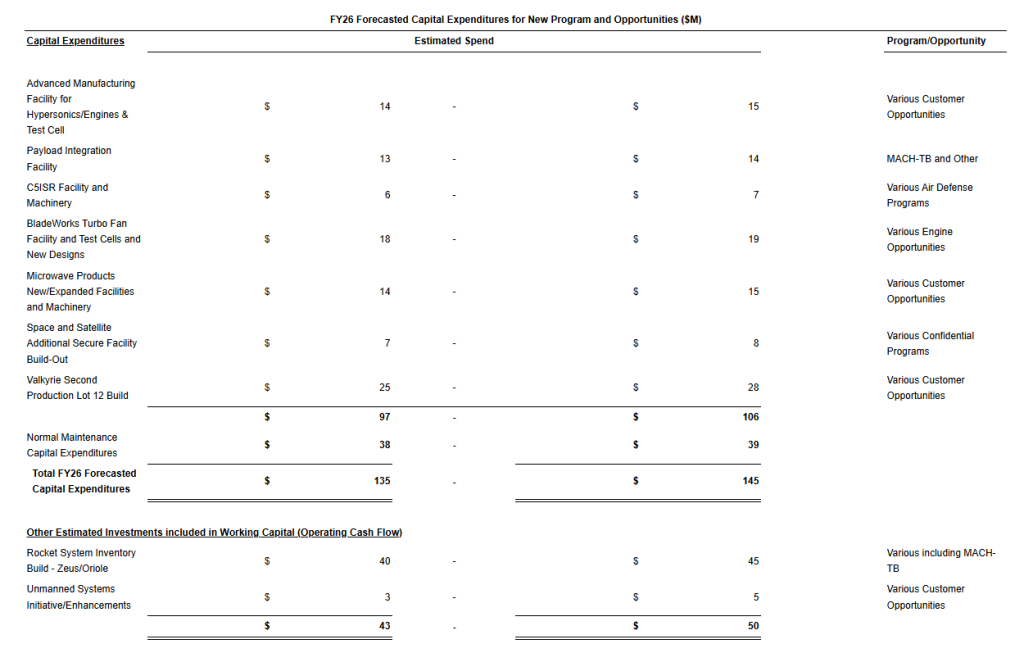
Kratos’ operating cash flow guidance also assumes certain investments in our Rocket Systems and Unmanned Systems businesses, related to the procurement of rocket and related systems and our plan to begin producing approximately 40 Valkyries annually beginning by the end of 2027 as well as the completion of certain of our unmanned systems and related derivatives and vehicles. Additional forecasted investments in 2026 include our funding of the Prometheus joint venture established last year, our Anaconda radar program, our Helios hypersonic and arc chamber program, our Indiana hypersonic integration facility, our Birmingham advanced manufacturing facility for hypersonics, expansion and new microwave electronics facilities in Israel and the US, our GEK and BladeWorks engine facilities, the continued build of our second lot of 12 Valkyrie aircraft, and our Vulcan, Kraken, Elysium, Nemesis, Hermes and other initiatives. In summary, Kratos continues to make the required investments to support the rebuild of the U.S. defense industrial base and related infrastructure, take advantage of the ongoing generational recapitalization of strategic and other weapon and National Security related systems, and generate value for all Kratos stakeholders, including the warfighter and Kratos shareholders.
Our first quarter and full year Base Case 2026 guidance ranges, which includes the recently closed Nomad Global Communication Solutions acquisition, and a summary of the forecasted investments for new programs and opportunities are presented below.
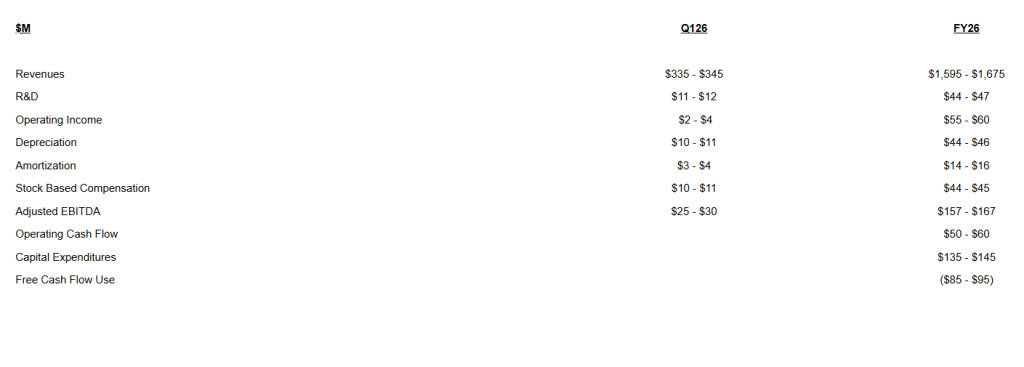
For Kratos’ Base Case fiscal year 2026 forecast, we currently expect the first fiscal quarter to be the lowest in both revenue and Adjusted EBITDA, including as a result of the extended U.S. Federal Government shutdown in the fourth quarter of fiscal 2025, which impacted government contracting, program, administrative and other functions and offices. The impact of the shutdown, we believe, resulted in among other issues, the delay of certain “short turn” contract awards to Kratos, including certain expected software, data related and product sales, which typically generate higher than our normal profit margins. We believe the government shutdown also resulted in a delay in the award of certain longer-term contracts, programs and funding. With the government shutdown now over and the Department of War (DoW) and related Federal Agencies at full function again, we expect to receive these contract and program awards, sales and funding, beginning in our second quarter of 2026. The expected overall lower revenue in our first fiscal quarter is expected to result in lower Adjusted EBITDA, including as a result of the loss of financial leverage on certain of our fixed general, administrative, overhead, infrastructure, bid, proposal and other costs, with a more pronounced impact as we have expanded our infrastructure to support our growing businesses.
Also contributing to our expectation that Kratos second half of fiscal 2026 will have significantly higher Revenue and Adjusted EBITDA than the first half, we expect to begin to receive in the second half of 2026 certain long lead items related to existing customer funded programs, including solid rocket motors and other hardware related to certain hypersonic and other programs, hardware and components related to jet engine and propulsion system development and production, and hardware related to air defense, missile, radar and other National Security system production.
As a result of all of the above, we expect Kratos’ second quarter of fiscal 2026 to have somewhat increased Revenue and Adjusted EBITDA over our fiscal first quarter, and we expect Kratos’ second half of fiscal year 2026 Revenue, Adjusted EBITDA and operating cash flow to be greater than our first half, as our Revenue increases, Adjusted EBITDA margins are expected to expand and contract funding is expected to increase. All financial forecasts provided today include the expected contribution from the recently closed acquisition of Nomad Global Communication Solutions, Incorporated.
We continue to expect Base Case Kratos’ full year 2026 organic revenue growth to be approximately 15 percent to 20 percent above our full year fiscal 2025 revenue financial forecast, which we previously provided in November 2025, and which we exceeded. We continue to expect Kratos’ Base Case full year 2027 organic revenue growth to be approximately 18 percent to 23 percent above the full year fiscal 2026 revenue forecast we provided today. We continue to expect Kratos’ full year 2026 Adjusted EBITDA margin rates to be approximately 100 bps greater than our reported 2025 Adjusted EBITDA margin rates. And we continue to expect our current forecast 2027 Adjusted EBITDA margin rates to increase an additional 100 bps above 2026 Adjusted EBITDA margin rates. Kratos’ Base Case Revenue and Adjusted EBITDA forecasts do not include large scale production of Kratos Valkyrie or other tactical drone production, which will only be included once Kratos receives definitized customer delivery schedules that we can accurately forecast. Additionally, none of the above financial information includes the estimated impact from the pending Orbit Technologies Ltd acquisition, which financial information will only be included once the acquisition closes.
Management will discuss the Company’s financial results at a conference call beginning at 2:00 p.m. Pacific (5:00 p.m. Eastern) today. The call will be available at www.kratosdefense.com. Participants may register for the call using this Online Form. Upon registration, all telephone participants will receive the dial-in number along with a unique PIN that can be used to access the call. For those who cannot access the live broadcast, a replay will be available on Kratos’ website.
About Kratos Defense & Security Solutions
Kratos Defense & Security Solutions, Inc. (NASDAQ: KTOS) is a technology, hardware, products, system and software company addressing the defense, national security, and commercial markets. Kratos makes true internally funded research, development, capital and other investments, to rapidly develop, produce and field relevant solutions that address our customers’ mission critical needs and requirements. At Kratos, affordability is a technology, and we seek to utilize proven, leading-edge approaches and technology, not unproven bleeding edge approaches or technology, with Kratos’ approach designed to reduce cost, schedule and risk, enabling us to be first to market with cost effective solutions. We believe that Kratos is known as the innovative disruptive change agent in the industry, a company that is an expert in designing products and systems up front for successful rapid, large quantity, low-cost future manufacturing, which is a value-add competitive differentiator for our large traditional prime system integrator partners and also to our government and commercial customers. Kratos intends to pursue program and contract opportunities as the prime or lead contractor when we believe our probability of win is high and any investment required by Kratos is within our capital resource comfort level. We intend to partner and team with a large, traditional system integrator when our assessment of probability of win is greater or required investment is beyond Kratos’ comfort level. Kratos’ primary business areas include, virtualized ground systems for satellites and space vehicles including software for command & control (C2) and telemetry, tracking and control (TT&C), jet powered unmanned aerial drone systems, hypersonic vehicles and rocket systems, propulsion systems for drones, missiles, loitering munitions, supersonic systems, space craft and launch systems, command, control, communication, computing, combat, intelligence surveillance and reconnaissance (C5ISR) and microwave electronic products for missile, radar, air defense, missile defense, space, satellite, counter unmanned aircraft systems (CUAS), directed energy, communication and other systems, and virtual & augmented reality training systems for the warfighter. For more information, visit www.KratosDefense.com
Notice Regarding Forward–Looking Statements
This news release contains certain forward-looking statements that involve risks and uncertainties, including, without limitation, express or implied statements concerning the Company’s expectations regarding its future financial performance, including the Company’s expectations for its first quarter, second quarter, first half, second half, and full year 2026 revenues, R&D, operating income, depreciation, amortization, stock based compensation expense, and Adjusted EBITDA, and full year 2026 operating cash flow, capital expenditures, investments, and free cash flow, forecasted company and business unit organic revenue growth, estimated revenue and organic revenue growth for 2026 and 2027, Adjusted EBITDA margins in 2026 and 2027, future initiation of higher margin programs and negotiation of lower margin contracts which are expected to be renewed in the future, expected future investments in property, plant, facilities, and equipment (including expected investments in the Prometheus joint venture and other programs, opportunities, and initiatives), expected future production of Valkyries, the ability of the Company’s customers to respond to industry and market conditions, the impact of acquired companies and businesses on the Company’s operations and financial condition, the Company’s bid and proposal pipeline and backlog, including the Company’s ability to timely execute on its backlog, demand for its products and services, including the Company’s alignment with today’s National Security requirements and the positioning of its C5ISR and other businesses, ability to successfully compete and expected new customer awards, the impact of federal government shutdowns on the Company’s operations and financial condition, the availability and timing of government funding for the Company’s offerings, availability of an experienced skilled workforce, inflation and increased costs, risks related to potential cybersecurity events or disruptions of our information technology systems, and delays in our financial projections, industry, business and operations, including projected growth. Such statements are only predictions, and the Company’s actual results may differ materially from the results expressed or implied by these statements. Investors are cautioned not to place undue reliance on any such forward-looking statements. All such forward-looking statements speak only as of the date they are made, and the Company undertakes no obligation to update or revise these statements, whether as a result of new information, future events or otherwise. Factors that may cause the Company’s results to differ include, but are not limited to: risks to our business and financial results related to the reductions and other spending constraints imposed on the U.S. Government and our other customers, including as a result of sequestration and extended continuing resolutions, the Federal budget deficit and Federal government shut-downs; risks of adverse regulatory action or litigation; risks associated with debt leverage; risks that our cost-cutting initiatives will not provide the anticipated benefits; risks that changes, cutbacks or delays in spending by the DoW may occur, which could cause delays or cancellations of key government contracts; risks of delays to or the cancellation of our projects as a result of protest actions submitted by our competitors; risks that changes may occur in Federal government (or other applicable) procurement laws, regulations, policies and budgets; risks of the availability of government funding for the Company’s products and services due to performance, cost growth, or other factors, changes in government and customer priorities and requirements (including cost-cutting initiatives, the potential deferral of awards, terminations or reduction of expenditures to respond to the priorities of Congress and the Administration, or budgetary cuts resulting from Congressional committee recommendations or automatic sequestration under the Budget Control Act of 2011, as amended); risks that the unmanned aerial systems and unmanned ground sensor markets do not experience significant growth; risks that products we have developed or will develop will not become programs of record; risks that we cannot expand our customer base or that our products do not achieve broad acceptance which could impact our ability to achieve our anticipated level of growth; risks of increases in the Federal government initiatives related to in-sourcing; risks related to security breaches, including cyber security attacks and threats or other significant disruptions of our information systems, facilities and infrastructures; risks related to our compliance with applicable contracting and procurement laws, regulations and standards; risks related to the new DoW Cybersecurity Maturity Model Certification; risks relating to the ongoing conflict in Ukraine and the Israeli-Palestinian military conflict; risks to our business in Israel; risks related to contract performance; risks related to failure of our products or services; risks associated with our subcontractors’ or suppliers’ failure to perform their contractual obligations, including the appearance of counterfeit or corrupt parts in our products; changes in the competitive environment (including as a result of bid protests); failure to successfully integrate acquired operations and compete in the marketplace, which could reduce revenues and profit margins; risks that potential future goodwill impairments will adversely affect our operating results; risks that anticipated tax benefits will not be realized in accordance with our expectations; risks that a change in ownership of our stock could cause further limitation to the future utilization of our net operating losses; risks that we may be required to record valuation allowances on our net operating losses which could adversely impact our profitability and financial condition; risks that the current economic environment will adversely impact our business, including with respect to our ability to recruit and retain sufficient numbers of qualified personnel to execute on our programs and contracts, as well as expected contract awards and risks related to increasing interest rates; currently unforeseen risks associated with any public health crisis, and risks related to natural disasters or severe weather. These and other risk factors are more fully discussed in the Company’s Annual Report on Form 10-K for the period ended December 28, 2025, and in our other filings made with the Securities and Exchange Commission.
Note Regarding Use of Non-GAAP Financial Measures and Other Performance Metrics
This news release contains non-GAAP financial measures, including organic revenue growth rates, Adjusted EPS (computed using income before income taxes, excluding depreciation, amortization of intangible assets, amortization of capitalized contract and development costs, stock-based compensation expense, acquisition and restructuring related items and other, which includes, but is not limited to, legal related items, non-recoverable rates and costs, and foreign transaction gains and losses, less the estimated impact to income taxes) and Adjusted EBITDA (which excludes, among other things, acquisition and restructuring related items, stock compensation expense, foreign transaction gains and losses, and the associated margin rates). Additional non-GAAP financial measures include Free Cash Flow from Operations computed as Cash Flow from Operations less Capital Expenditures plus proceeds from sale of assets and Adjusted EBITDA related to our KUS and KGS businesses. Kratos believes this information is useful to investors because it provides a basis for measuring the Company’s available capital resources, the actual and forecasted operating performance of the Company’s business and the Company’s cash flow, excluding non-recurring items and non-cash items that would normally be included in the most directly comparable measures calculated and presented in accordance with GAAP. The Company’s management uses these non-GAAP financial measures, along with the most directly comparable GAAP financial measures, in evaluating the Company’s actual and forecasted operating performance, capital resources and cash flow. Non-GAAP financial measures should not be considered in isolation from, or as a substitute for, financial information presented in compliance with GAAP, and investors should carefully evaluate the Company’s financial results calculated in accordance with GAAP and reconciliations to those financial results. In addition, non-GAAP financial measures as reported by the Company may not be comparable to similarly titled amounts reported by other companies. As appropriate, the most directly comparable GAAP financial measures and information reconciling these non-GAAP financial measures to the Company’s financial results prepared in accordance with GAAP are included in this news release.
Another Performance Metric the Company believes is a key performance indicator in our industry is our Book to Bill Ratio as it provides investors with a measure of the amount of bookings or contract awards as compared to the amount of revenues that have been recorded during the period and provides an indicator of how much of the Company’s backlog is being burned or utilized in a certain period. The Book to Bill Ratio is computed as the number of bookings or contract awards in the period divided by the revenues recorded for the same period. The Company believes that the rolling or last twelve months’ Book to Bill Ratio is meaningful since the timing of quarter-to-quarter bookings can vary.
Press Contact:
Claire Cantrell
[email protected]
Investor Information:
877-934-4687
[email protected]

Source: Kratos Defense & Security Solutions, Inc.